AI in 2026 Is the Most Dangerous Technology Humanity Has Approached, Bill Gates Warns
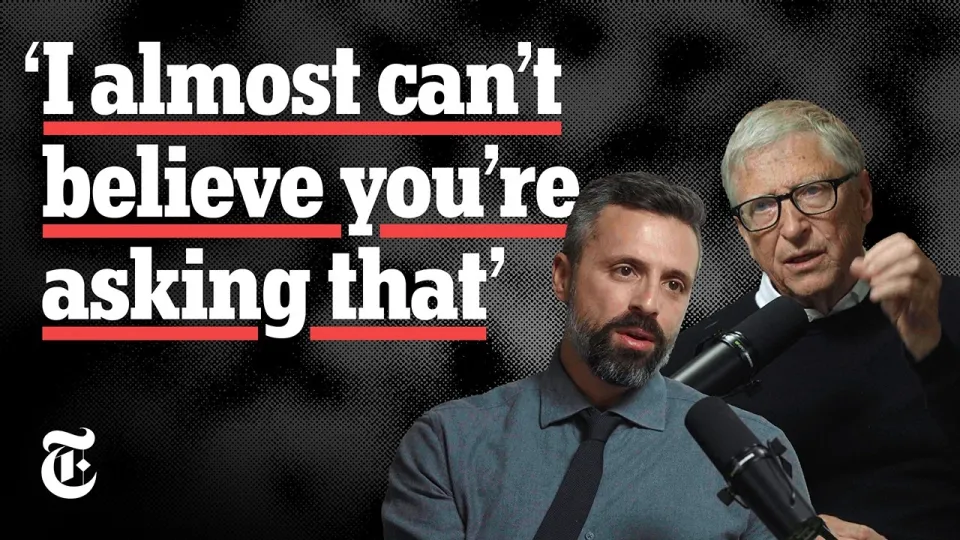
Video: Bill Gates: A.I. ‘Makes Nuclear Weapons Look Like Nothing’ | The Ezra Klein Show
Need articles like this for your video? They help promote it on YouTube and Google — order them in the Telegram bot @sat_sit_bot. The bot writes and publishes the articles itself (with your YouTube video embedded) on popular topical websites (no ads). Try it free: 50 articles on us.
· based on the channel The Ezra Klein Show
Bill Gates argues that AI is the most dangerous technology humanity has ever approached, and that it makes nuclear weapons look almost trivial by comparison. In a conversation with Ezra Klein, he says the next few years will bring catastrophic cyberattacks, bio-terrorism and mass job loss unless governments regulate the industry directly. The full interview and transcript are available through the New York Times opinion page for the episode.
Why Bill Gates says AI makes nuclear weapons look like nothing
Gates frames AI risk as a category shift rather than an incremental hazard: nuclear weapons are bounded by physics, fissile material and launch chains, while AI risk is bounded by nothing physical at all. His argument rests on three properties that make artificial intelligence harder to contain than any earlier technology.
- Speed. Software capabilities can be copied and deployed globally at effectively zero marginal cost, so a dangerous capability does not stay in one lab.
- Opacity. The people building frontier models cannot fully explain what a model will do in a novel situation, which makes pre-deployment assurance weak.
- Access. The same model that drafts legal briefs can be pointed at a pathogen database or a power grid, so defensive and offensive use share one toolchain.
Gates is not describing a distant science-fiction scenario. He is describing a gap between capability and governance that he believes is already open, and widening faster than institutions can close it.
The cyber and bio thresholds where AI risk turns physical
Gates points to two thresholds where AI stops being an abstract policy debate and starts producing body counts: cyber and bio. On the cyber side, he expects AI-assisted attacks on critical infrastructure — grids, hospitals, financial settlement systems — that outpace human defenders because the attacker only needs one success. On the bio side, he worries that model assistance could lower the skill and equipment barrier for producing dangerous biological agents, turning a state-level capability into something a small group could attempt.
The asymmetry matters more than the probability. A single catastrophic event in either category would overwhelm the response capacity of any legal system, which is why Gates treats these thresholds as the trigger for binding rules rather than voluntary pledges.
Why Gates calls AI self-regulation insane
Gates is blunt that the idea the AI industry can police itself is "insane," and his reasoning is structural rather than personal. Companies compete on capability and speed, shareholders reward shipping, and the cost of a bad outcome falls on people who never consented to the experiment. Voluntary commitments also fail the test of verifiability: no competitor can audit another lab's training run, and no regulator can see inside a model it is not allowed to inspect.
His sharpest illustration is legal, not technical. If a model-assisted attack killed 100 million people, a lawsuit would be a meaningless remedy — courts assign damages after harm, and there is no defendant balance sheet that can absorb that loss. Gates' conclusion is that pre-deployment testing, licensing and liability rules have to be written by governments, with the industry consulted rather than trusted.
The race with China and the case for coordinated rules
Gates treats the US–China AI race as the strongest argument for regulation rather than against it. In a pure capability race, each side's safest move is to go faster than the other, which pushes both toward the thresholds described above. His preferred path is a shared floor: agreed red lines on cyber and bio capabilities, mutual inspection, and treaty-style commitments that survive changes of government.
That is a hard sell in any political climate, and Gates acknowledges it. But he argues that the alternative — two rival blocs each assuming the other will cheat — produces exactly the race dynamics that make catastrophic outcomes more likely, not less.
What AI does to jobs and why Gates talks about a no-scarcity labor market
Gates expects AI to compress the timeline for job disruption rather than eliminate work outright. The near-term damage, in his account, is concentrated in entry-level cognitive roles — the tasks that used to be how young workers built judgment — and in economies that cannot retrain at scale.
He sketches several responses:
- Taxing AI labor. Treat automated output as taxable activity so that the productivity gains fund transition support instead of concentrating in a handful of firms.
- "Human reserved" jobs. Designate roles — care work, teaching, certain public services — where human presence is the point, not an inefficiency to be optimized away.
- A no-scarcity job market. If AI makes goods and services dramatically cheaper, the policy question shifts from protecting existing jobs to distributing the surplus, which requires institutions most countries do not yet have.
He is equally concerned about developing nations, where AI-driven automation could remove the low-cost labor ladder that countries like his foundation's partners have historically climbed. That is part of why the Gates Foundation, which is set to spend down around $200 billion over the next two decades, has made steering AI toward equality a new priority.
Common questions about Gates' AI warnings
Viewers of the interview reacted with a mix of alarm and skepticism, and several recurring doubts are worth addressing directly.
"Isn't this just alarmism from someone who built a monopoly?" Gates' record does not immunize him from criticism, but the argument stands on its own: the cyber and bio thresholds are empirical claims about capability, not about the character of any one company.
"Won't capitalism fix this because harming customers is bad for business?" That logic works for products where harm is visible, attributable and repeatable. It fails for low-probability, civilization-scale events, where the firm that moves fastest captures the upside and the public absorbs the tail risk.
"Why is Gates more agitated now than in earlier interviews?" The shift tracks the capability curve. What changed is not his temperament but the timeline: capabilities he once expected decades out are arriving while regulators are still drafting definitions.
"What about children and schools?" Gates argues that AI in education needs its own rules — age-appropriate safeguards, limits on data collection, and clear guidance for schools — separate from the general regulatory debate, and he points to learning loss in rich countries as evidence that the current system is not delivering.
Useful links
- Full transcript and episode page for the Bill Gates interview on The Ezra Klein Show
- Book recommendations from guests of The Ezra Klein Show
The bottom line on Gates' AI warning
Gates' message is not that AI should be stopped, but that the gap between what the technology can do and what governments are prepared to do about it is the defining risk of the moment. He puts cyber and bio risk above nuclear weapons, rejects self-regulation as unserious, and expects job disruption to arrive faster than retraining systems can respond. The discomfort in the conversation — visible enough that viewers noticed how agitated he seemed — comes from his belief that people in authority are not treating any of this as urgent. The full discussion, including his comments on the Gates Foundation's spending plans and education, is in this episode of The Ezra Klein Show; start with the transcript.
Key takeaways
- Gates calls AI the most dangerous technology humans have ever approached, saying it makes nuclear weapons look like nothing.
- He identifies two thresholds — catastrophic cyberattacks and bio-terrorism — as the first places AI risk becomes physical.
- Gates calls industry self-regulation of AI "insane" and argues lawsuits cannot answer a threat that could kill 100 million people.
- The Gates Foundation, set to spend down around $200 billion over two decades, has made AI-driven inequality a new priority.
- Gates warns of mass job loss and a race with China, and pushes for child-specific AI regulation and "human reserved" roles.
Source: Bill Gates: A.I. ‘Makes Nuclear Weapons Look Like Nothing’ | The Ezra Klein Show · Markdown version
Questions & answers
Why does Bill Gates say AI makes nuclear weapons look like nothing?
Gates argues that nuclear risk is constrained by physical materials, launch procedures and state control, while AI risk is constrained by none of those. Capabilities can be copied instantly, models are not fully explainable even to their builders, and the same tools serve both defensive and offensive purposes. That combination, he says, produces a hazard category larger than the nuclear one.
What does Gates mean when he calls AI self-regulation "insane"?
He means that voluntary industry commitments cannot be verified, audited or enforced across competitors, and that firms are rewarded for shipping capability faster than rivals. Gates points out that a lawsuit is a meaningless remedy for a catastrophic event, so rules have to be written and enforced before deployment rather than after harm.
Which risks does Gates consider most urgent?
He names two thresholds: AI-enabled cyberattacks on critical infrastructure and bio-terrorism assisted by model capabilities. In both cases a single successful attack could exceed the response capacity of any legal or insurance system, which is why he treats them as the trigger for binding government rules.
How does Gates propose to handle AI's impact on jobs?
He suggests taxing AI labor so productivity gains fund transition support, designating "human reserved" roles in care work, teaching and public services, and preparing for a no-scarcity job market where the policy problem becomes distributing cheap output. He also warns that developing economies could lose the low-cost labor ladder they have historically relied on.